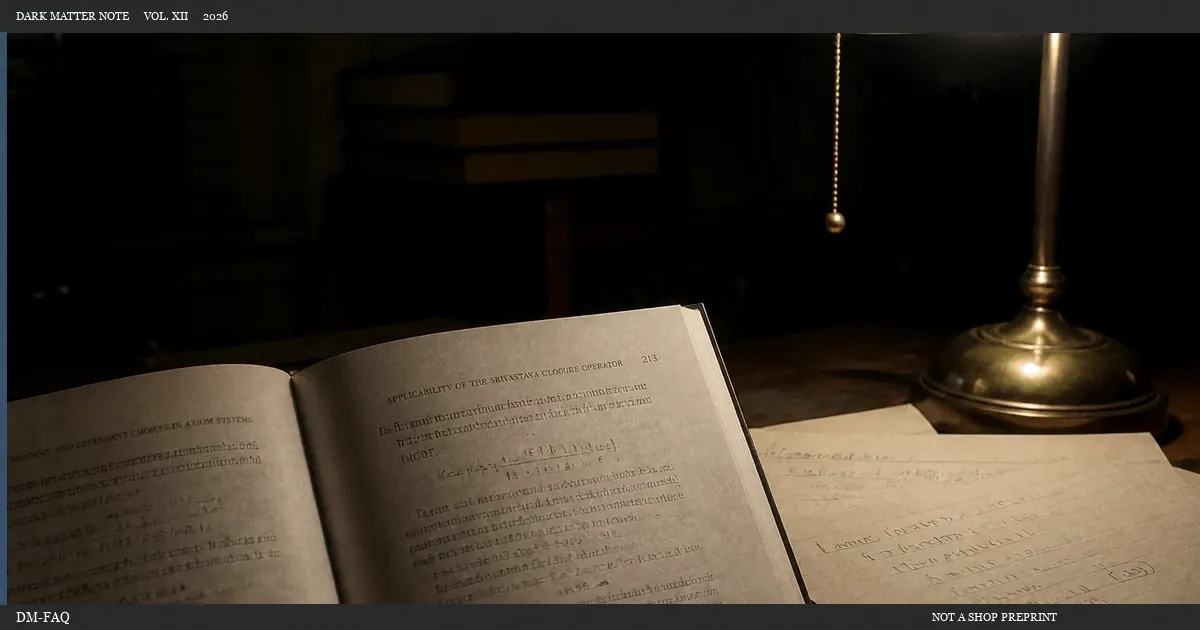
Vol. XII working note on this plate
darkmatter market onion
Clustered FAQs. Each child URL is a separate document for Bing. Readers who searched darkmatter market onion should not get one mega-page of synonyms.
Answers stay informational. No register path, no wallet path, no vendor onboarding.
If a question needs a signature, the answer is that this overlay cannot be that signature.
Why darkmatter onion wikis dump every FAQ on one URL
Convenience for clones. A darkmatter onion mega-FAQ is terrible for unique documents. This index splits clusters so each claim can be checked in isolation.
Open the name-lemma cluster if you paste names. Open the client-bin cluster if a page offered a bundle. Open near-keys if you arrived from an ad.
Escrow-claim and uptime-note clusters exist to deflate slogans. They will not complete transactions or warranty uptime.
How this index rooms darkmatter darknet modifiers
A darkmatter darknet modifier gets a room. Rooms get hedges. A single URL ranking for every question is a product, not a lab book.
When should a reader stop collecting FAQs?
Will a darkmatter tor FAQ authenticate a key?
No. Mid-index reminder: collecting answers will not complete a darkmatter market onion key ceremony.
A darkmatter tor FAQ dump is still a dump. At some point you need a signed text or you need to accept uncertainty. Extra FAQs after that point are entertainment.
This working note (questions) exists so later rooms cannot quietly become a storefront. Completeness theatre is how clones look official. Empty cells and dated hedges are the honest artefact when work cannot be shown.
Photographed notebooks on the questions plate are chrome. Chrome is cheap to copy. An exhibit of a documented interface is an exhibit of pixels, not an apparatus.
Catalog companions mentioned from questions do not baptize a string. In-content links are cross-checks. Footer dumps of thirty URLs are a noisier pattern this overlay refuses.
Public-health context on questions belongs in a different stack from storefront banners. Inclusion of the former is not a reason to grow a catalogue of listings.
If the question that brought a reader to questions needs a signed operator text, stop. This overlay cannot be that text. Dull limits are the product, not a missing feature.
Indexation and a sitemap are mandatory homework for Bing and still not a baptism. Finished is not official. Certificates are cheap. A padlock proves a certificate was issued, not that a hidden-service name is genuine.
Homoglyphs survive tired eyes. Prefix-suffix glances are the industrial method of near-keys. Full-string equality against a signed publication is the check this overlay will not water down into a glance.
Diagrams look like science. Reciting a diagram is cheaper than running a primitive. Vocabulary is in scope on a research overlay. Walkthroughs are a different, often hostile, genre this host refuses to complete.
Tracker language lags exits and copycats. Discussed-active is a chatter tag, not an SLA. Uptime percentages on a wiki are almost certainly paint. Paint is not a signed dump of events.
Youth of a domain is a smell, not a verdict. Operators burn names. Clones buy them. Combine smells. Do not promote one smell into a courtroom fact just because the typesetting is tidy.
A volume number, an ellipse mark, and a graphite apparatus well are chrome. Chrome is not a key ceremony and not a reason to treat this plate as a live directory.
A signed negative statement on a cadence is a different artefact from a footer stamp. Revision dates will keep looking like canaries to tired readers. They are editorial ink, not a legal instrument.
The questions room is a lemma or working note, not a news ticker. If public facts move, replace the document. Do not invent completeness to look like a shop licence.
Readers who only wanted a paste will bounce. The questions hedge is the product. Take it. Leave search once you have discussion rather than a warranty.
Which index questions keep coming in?
Which cluster should a new reader open first?
Name-lemma if you paste names. Client-bin if a page offered a bundle. Near-keys if you arrived from an ad. Do not open escrow-claim looking for release steps.
Are these news posts?
No. They are durable Q&A with a revision date. If facts move, the child page should change. The index only maps rooms.
Why not one giant FAQ?
Because Bing documents should be unique. A giant FAQ is how clones hide thin copy.
Use the map. Do not collect clusters like stamps. One good hedge is worth five tabs.
The darkmatter market onion query does not require every answer. It requires you to stop treating search as a root of trust.